

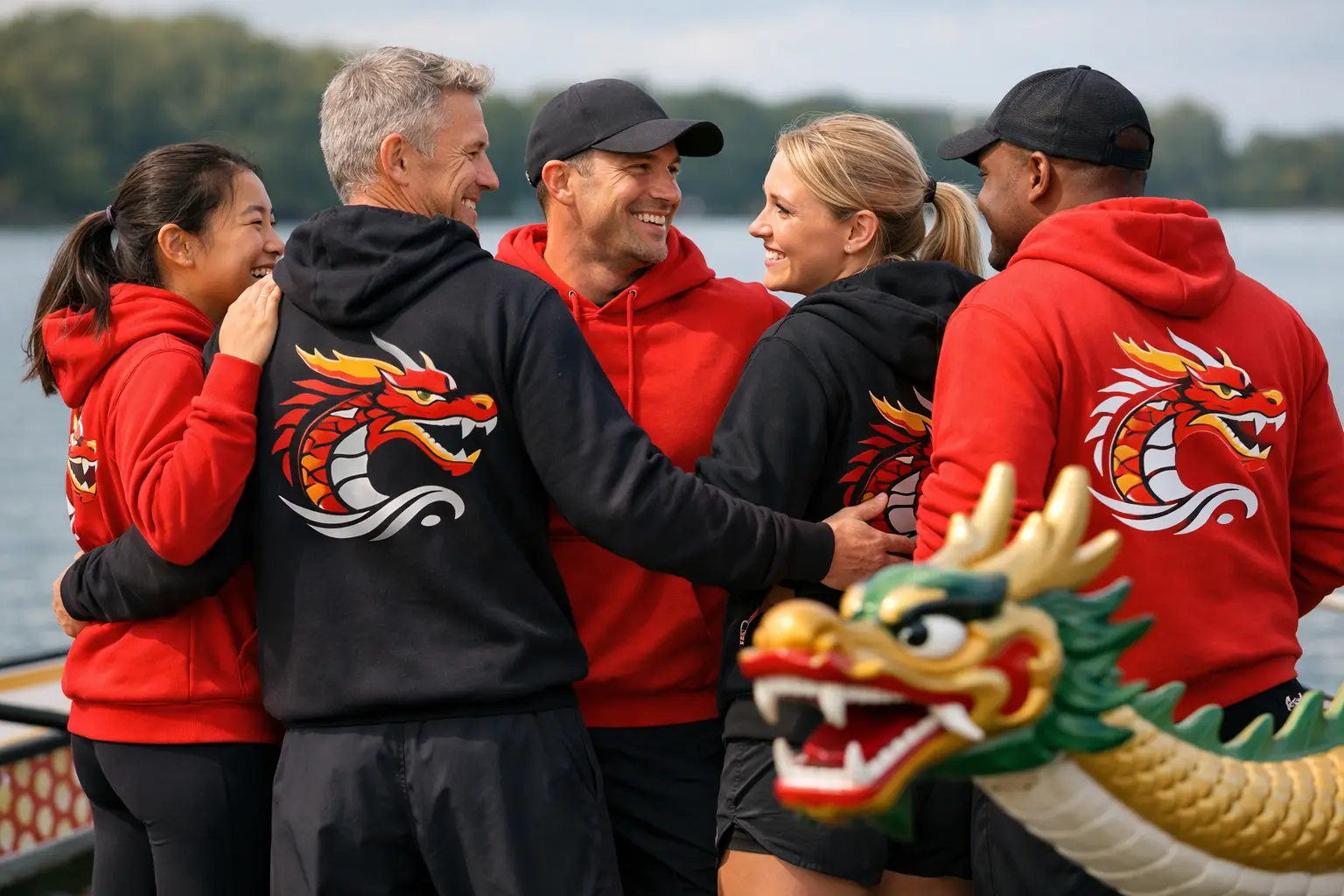
The trailer park is busy, the first race briefing is still an hour away, and half the crew has arrived in layers against a cool morning. That is when dragon boat team hoodies do more than fill a kit bag. They make the squad immediately recognisable, keep paddlers comfortable before launch, and give everyone a shared piece of club identity long after the finish line.
For dragon boat teams, a hoodie is not simply a casual extra. It is the layer worn at early training sessions, on the journey to regattas, between heats and at the post-race gathering. Get it right and it becomes the garment members reach for repeatedly. Get it wrong and it becomes the leftover kit sitting at the bottom of a drawer.
Why dragon boat team hoodies earn their place
Race jerseys and rashies have a clear performance role on the water. Hoodies work around it. They provide warmth while the crew is rigging, offer a practical layer after paddling, and help teams present a united look when travelling, volunteering or supporting other boats.
That versatility matters for clubs managing a mixed calendar. A heavyweight hoodie may be ideal for spring sessions on the Thames or a windy coastal venue, while a lighter option suits summer events, overseas racing and everyday club wear. The right choice depends on when and where your team paddles, not just on which colour looks best on a design proof.
There is also a community benefit. New paddlers often receive their first team hoodie before they have raced a full season. It is a visible welcome into the crew. For established members, it carries memories of campaigns, festivals and early starts shared with the same people year after year.
Choosing dragon boat team hoodies for real club use
A strong hoodie specification starts with the situations it needs to handle. Think about the full day rather than the five minutes before a team photograph. Will it be pulled over damp kit? Worn while loading boats? Packed for a weekend away? Used by coaches and supporters as well as paddlers?
Weight, warmth and movement
Fabric weight is a practical decision. A warmer brushed interior is welcome when temperatures drop, but can feel bulky in a crowded kit bag or during humid travel. Lighter hoodies are easier to wear across a longer season, although they will not replace a proper outer layer in cold rain.
Fit matters just as much. A hoodie needs enough room for a base layer or race top underneath without looking oversized in team photos. Consider the range of body shapes across your squad and use a clear size chart before collecting orders. Offering adult unisex sizing is often the simplest approach, but clubs with a broad membership may benefit from a wider fit range where available.
Details such as a useful hood, comfortable cuffs and a pocket that sits well under a jacket can influence whether members actually wear the garment. These are small decisions, but paddlers notice them at 6am on a wet training day.
Print that remains part of the team identity
A hoodie must look sharp from a distance, not only on a computer screen. Club names, boat names and logos should remain clear when viewed across a race village. A well-balanced design normally gives the main logo room to breathe, then uses sleeve, chest or back placement for the crew name, sponsor details or event recognition.
Sublimation printing is particularly useful when the design calls for full colour, gradients, paddle-inspired graphics or large-scale artwork. It avoids the heavy feel that can come with a large surface print and allows the garment to carry a distinctive club pattern. Embroidery can add a more traditional, textured finish for selected logos, but it is worth considering where it sits and how it will feel under outerwear.
Avoid trying to include every club achievement, social media handle and sponsor message in one garment. Hoodies have generous print space, yet a crowded design can lose impact. Choose the elements that make your team recognisable first, then build the rest around them.
Make one design work across the whole kit range
The best club identity does not stop at one garment. Your hoodie should feel related to your race jersey, rashie, windbreaker, board shorts and social shirt, even when each item has a different job.
This does not mean every garment needs identical artwork. A race rashie may use brighter panels and technical visual lines for visibility on the water. A hoodie can use a cleaner version of the same colours, logo and type treatment for an off-water look that members will wear beyond the club. The common thread is consistency: the same recognised colours, the same correct logo files and a clear hierarchy of information.
Before approving artwork, ask whether it will still make sense if the team adds new members, creates a masters crew or attends an international event. Date-specific designs can be great for a limited regatta run, but an evergreen club hoodie is generally the safer choice for ongoing orders.
Organise the order before race deadlines close in
The difficult part of team hoodies is rarely choosing the colour. It is gathering accurate sizes, confirming names or numbers where required, obtaining committee sign-off and avoiding a late artwork change that puts delivery under pressure.
Start with a named order lead who can collect sizes and answer questions from members. Give the squad a fixed deadline, rather than chasing individual responses until the week before the event. It also helps to confirm whether supporters, alumni and coaches can join the order, as they often want matching off-water kit.
Use approved artwork and correct logo files from the outset. If a new design is needed, allow additional time for the development process and revisions. Once the finished design is approved, production planning becomes far more predictable. A strike-off confirmation is particularly valuable for custom work because it provides a final quality checkpoint before the wider order moves ahead.
At bluesupply.asia, standard lead times for finished approved designs are around 30 days. That is a useful planning benchmark, but it should not be treated as a reason to wait until the last moment. Major festivals, overseas freight, bank holidays and committee changes can all affect the practical timeline. Build in contingency, especially if the kit is needed for a season launch or a key championship.
Common choices that cause avoidable disappointment
The first is ordering solely by price. A cheaper hoodie can be the right call for a one-off volunteer event, but a club garment expected to last across seasons needs reliable construction, colour consistency and a design process that protects the approved artwork.
The second is treating sizing as an afterthought. Guessing from standard retail sizes creates exchanges, frustration and uneven stock. Share measurements, encourage members to check them, and order a small number of extras only if the budget allows.
The third is designing for a screen rather than a crew. Fine lines, small text and subtle tonal differences may look excellent on a laptop but disappear at a regatta. Clear contrast and considered logo placement usually produce the stronger result.
Finally, do not overlook the role of the hoodie after the racing ends. A good team garment should feel appropriate at a club social, while travelling or when paddlers are introducing the sport to friends. That broader wearability gives the order more value and keeps club pride visible between events.
A crew moves fastest when every person knows their place in the boat. The same thinking applies to team kit: choose a hoodie with a clear purpose, approve the details early, and give your paddlers something they will be proud to wear from the first warm-up to the final team photo.