

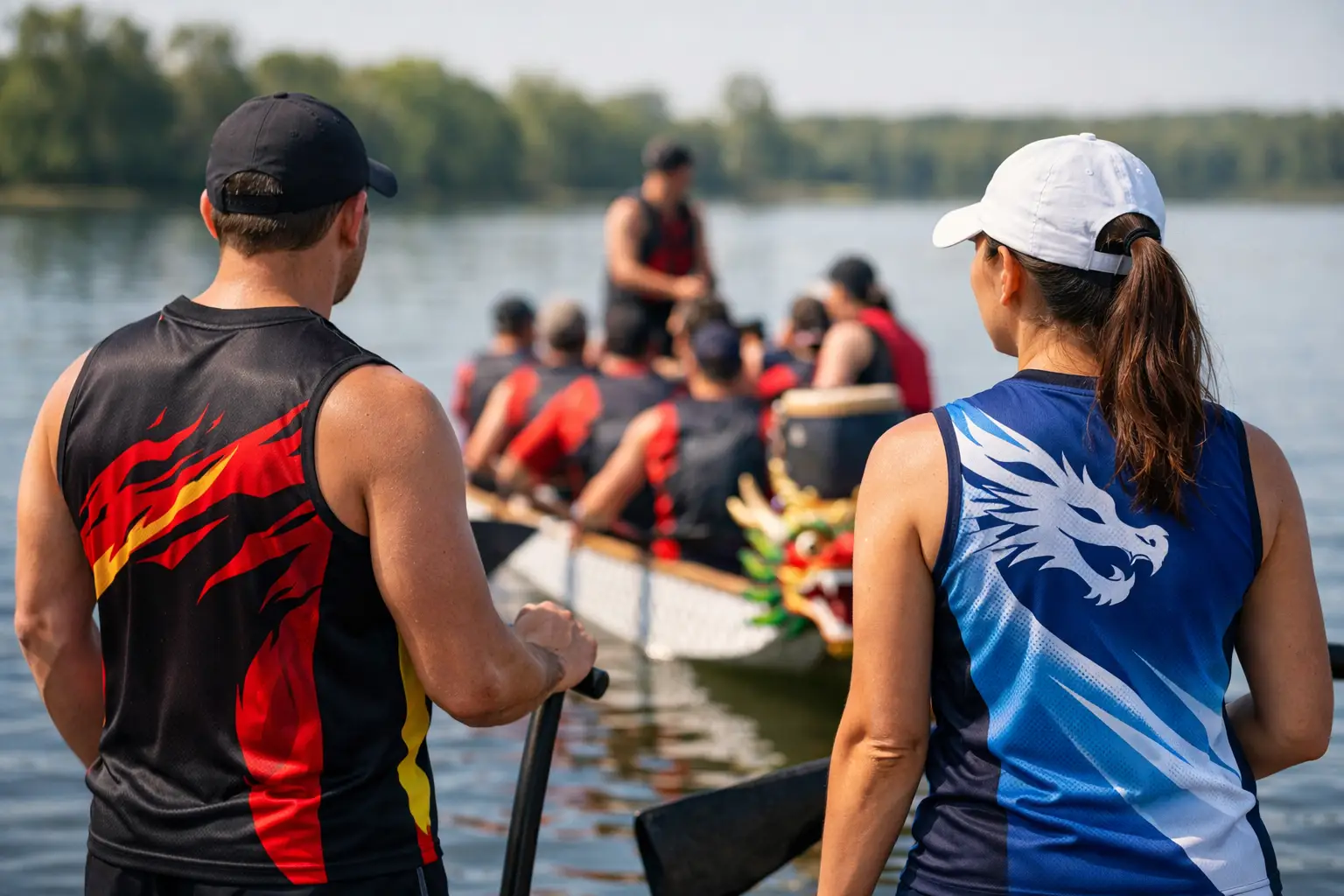
The start marshal is calling crews towards the water, the boat is rigged, and every paddler should look and feel part of the same unit. Dragon boat race jerseys are more than a club uniform in that moment. They are practical race kit, a clear team marker and a visible statement of the work your crew has put in together.
For captains and kit coordinators, the challenge is not simply choosing a shirt. It is getting the right garment style, a design the whole club can stand behind, accurate sizing across the squad and an order delivered in time for the first major event. The best results come from treating race jerseys as part of the team’s season plan, rather than a last-minute item on the regatta checklist.
What makes a good dragon boat race jersey?
A race jersey needs to work in the paddling position. That means freedom through the shoulders, a fit that does not bunch under a PFD or catch during the reach, and fabric that remains comfortable once the crew is warm, wet and working hard. A good jersey should support the paddler without becoming the thing they notice every stroke.
Sublimation-print performance garments are a strong choice for dragon boat teams because the design becomes part of the fabric rather than sitting on top of it. Names, crew numbers, sponsors, club colours and detailed graphics can be carried across the garment without the heavy, stiff feel that some applied prints create. The colour also has better consistency from one garment to the next when the artwork and production are properly controlled.
The right style depends on how and where your crew races. Racerback rashies offer maximum shoulder movement and are popular for hot-weather racing. Short-sleeve jerseys provide a familiar team look with lightweight coverage, while long-sleeve rashies can be more comfortable for cooler training blocks, sun protection or teams that prefer a more covered race-day appearance. There is no single correct format. Your climate, event calendar and team preference should lead the decision.
Design for recognition from the bank
Dragon boat racing is a visual sport. Spectators, organisers and photographers may see your boat for only a few seconds, often from a distance. A clear team identity helps your crew stand out on the water and gives your members something they are proud to wear at festivals, presentations and club socials.
Start with the elements that must be recognised quickly: your club name, core colours and logo. These should remain clear when a paddler is leaning forward, sitting in sequence or viewed side-on from the bank. Large areas of colour, confident contrast and legible lettering usually work better than overcrowding every panel with small details.
That does not mean a jersey has to be plain. Wave patterns, local references, animal motifs and strong geometric layouts can create a distinctive club look. The key is hierarchy. Let the team identity lead, then use supporting graphics to add energy and character. A design that looks impressive on a computer screen can lose impact once it is spread across different body shapes and broken up by paddles, PFDs and seat positions.
Keep the whole club in view
Race crews often include open, women’s, mixed, youth, senior and festival teams. If each group develops a completely separate jersey, the wider club identity can quickly become muddled. A more sustainable approach is to establish a core visual system – common colours, logo placement and typography – then adapt it for different crews or seasons.
This also makes it easier to add training tops, hoodies, windbreakers, board shorts and social shirts later. Your race jersey becomes the starting point for a joined-up club kit range, rather than a one-off garment that cannot be repeated.
Fit and sizing are team issues, not individual ones
The quickest way to undermine a smart jersey design is inconsistent fit across the boat. A team order needs a process that gives each paddler confidence in their size while allowing the person collecting the order to keep control of quantities, styles and deadlines.
Use a current size chart and encourage paddlers to measure against a garment they already wear comfortably for sport. Do not assume that a usual high-street size will translate directly to technical team apparel. Fit preference matters too. Some athletes want a close race fit; others may prefer a little more room, particularly if they layer clothing during training.
It is sensible to set a firm deadline for sizing responses, then circulate a final order list for checking before approval. Captains should also think beyond the active crew. New members, reserves, coaches and steers may need kit, and popular designs often prompt a second wave of orders from supporters. Ordering a small number of additional pieces can be useful, but it should be a deliberate decision rather than an expensive guess.
Choose garments for the conditions you actually face
A lightweight racerback may be perfect for a summer festival in Hong Kong, yet a British early-season training session can call for a different layer. Race jerseys are usually only one part of a paddler’s kit. Teams that plan well often pair their racing tops with long-sleeve rashies, windbreakers or hoodies for warm-up, recovery and travel.
Consider whether your crew wears buoyancy aids in competition, as this affects both comfort and visible branding. Check that important logos and names will still be seen above or around the PFD. If paddlers regularly race in changing weather, choose designs that remain recognisable when layered with other club garments.
Build enough time into the order
Great kit still needs a realistic production schedule. Artwork approval, individual sizing, design development, strike-off confirmation and production all take time, particularly when a club is ordering a broad size range or creating a new identity from scratch.
For finished approved designs, bluesupply.asia typically works to a lead time of around 30 days. A new design or substantial artwork changes require additional development time, so teams should avoid treating this as a final-week task before a key regatta. The closer an event gets, the fewer options you have for revisions, replacement pieces and calm decision-making.
A practical approach is to work backwards from your earliest important race. Allow time for the club committee to agree the direction, paddlers to submit sizes, artwork to be reviewed and the final design to be signed off. If your season includes an overseas event, factor in travel dates as well as race day. Kit needs to arrive early enough for every paddler to try it on and raise any concerns.
Quality control protects the design you approved
When a club commits its budget to custom kit, the approved artwork should be the artwork that reaches the boat. Colour balance, logo clarity, panel placement and sizing details all deserve attention before full production begins. A strike-off or sample confirmation is valuable because it turns a digital concept into something the team can assess in real conditions.
This is particularly relevant for designs using gradients, fine lines or multiple sponsor marks. These can look excellent, but they need careful preparation to reproduce cleanly on performance fabric. A production partner with paddling experience can flag potential issues early, advise on garment panels and help ensure the final result suits the movement and demands of racing.
Reliable dragon boat race jerseys should also hold up beyond one headline event. They need to tolerate regular washing, travel, sweaty training sessions and the reality of being packed into a kit bag after a wet race day. Looking after them is straightforward: rinse when needed, wash according to the garment guidance and avoid unnecessarily harsh heat. Good care keeps the colours sharp and helps the crew present a consistent image throughout the season.
Make race kit part of the club culture
The strongest team jerseys do not exist only for the start line. They are worn at land training, on coach trips, during medal presentations and in photos that stay with the club for years. That shared visual identity can help new paddlers feel included and remind experienced crew members that every seat contributes to the boat.
A well-planned jersey order also reduces pressure on volunteers. Clear design approval, organised size collection and realistic lead times create a smoother process for everyone involved. Get your quote early, bring your crew into the design conversation, and give your team kit the same attention you give your race preparation. When the boat lines up, every paddler should be ready to pull together.