

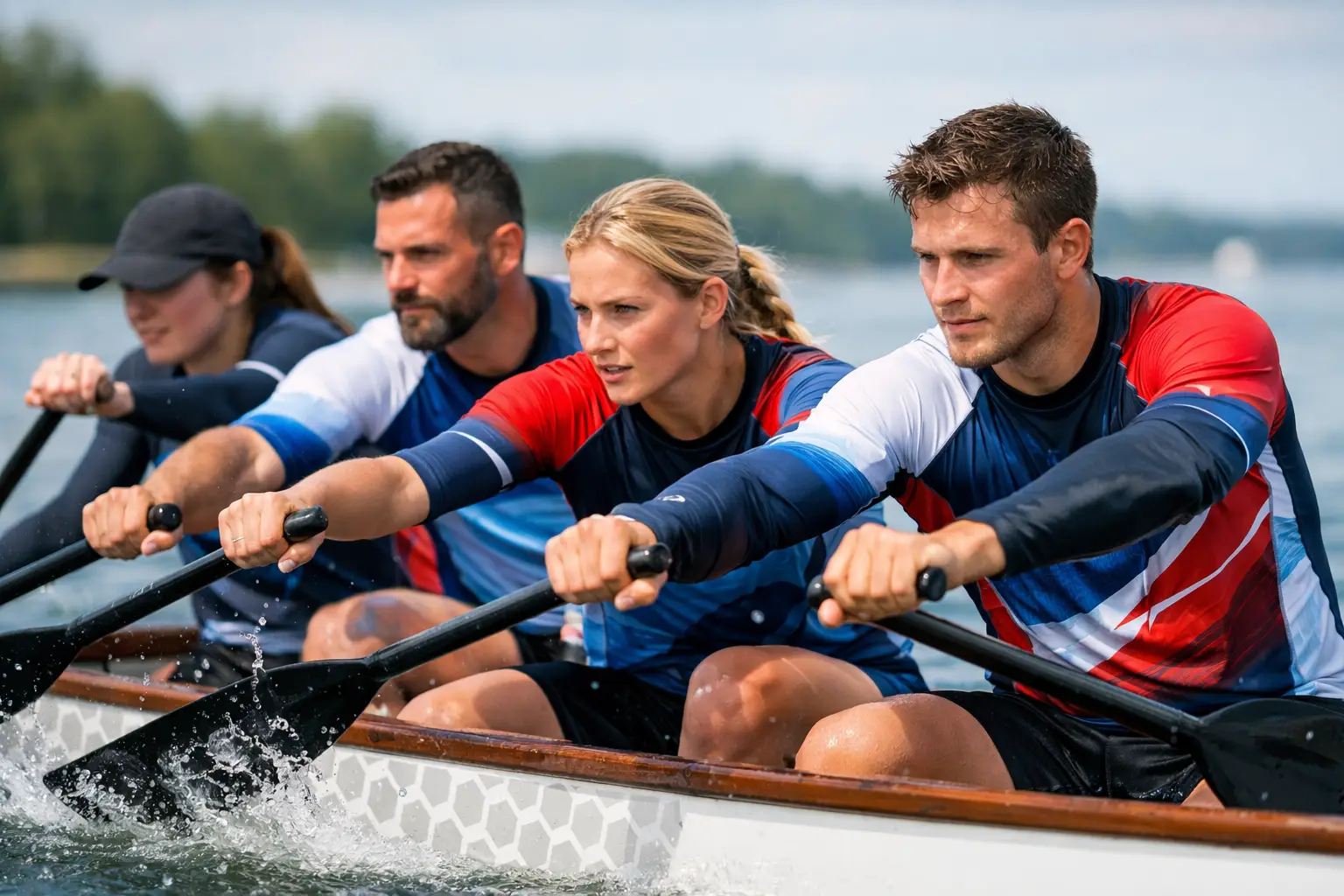
A rashie has a job beyond looking the part
At the start line, a paddling crew should look like one unit. But sublimated rashies for paddling are not simply a canvas for club colours. They need to sit comfortably through repeated reach and rotation, remain practical when training turns hot or wet, and keep every paddler recognisable from the pontoon to the finish line.
For dragon boat teams, outrigger crews and paddling clubs, a well-planned rashie brings together performance, identity and order-day practicality. It is the shirt worn at early-morning water sessions, at regattas when the weather changes quickly, and often at post-race team gatherings. Getting it right means thinking beyond a logo placed on the chest.
Why sublimation suits paddling teams
Sublimation printing puts the design into the garment fabric rather than applying a separate layer over its surface. For teams, that means club artwork, colours, names and sponsor details can become part of one considered design. There is no heavy printed panel to distract from the feel of the garment during a hard paddle session.
The creative freedom matters. A crew can use strong colour blocks that stand out on the water, a pattern drawn from its club history, or a cleaner race-day look with clear lane-side visibility. Colours can run across sleeves, side panels and backs without forcing the design into a small printable area. This is particularly useful when several squads share the same club identity but need distinct race, training or youth variations.
Durability is also a practical consideration. Paddling kit sees sun, spray, sweat, lifejacket friction and regular washing. A properly produced sublimated rashie is designed for regular active use, while the print remains integral to the fabric. That said, no garment is indestructible. Following the care guidance, rinsing salt water away after use and avoiding harsh laundry treatment will help the kit stay team-ready for longer.
Choose the right cut for the session
There is no single best rashie for every paddler or every race programme. Your choice should reflect the climate, the discipline, club preference and whether the garment is being used as a race top, a training layer or both.
Racerback rashies
A racerback cut is a popular choice where freedom around the shoulders is the priority. It can feel light during warm-weather training and gives a clear, athletic silhouette for crews that prefer a sleeveless race look. It may not suit paddlers who want more coverage from the sun or who expect cooler start times and long waits between heats.
Short-sleeve rashies
Short sleeves are often the most flexible club option. They provide more coverage while keeping a familiar team-shirt appearance, and can work well for mixed orders where paddlers have different preferences. For many clubs, this is the sensible all-round format for training and racing through much of the British season.
Long-sleeve rashies
Long sleeves offer additional coverage for bright days, cooler mornings and extended time on the water. They can also help give a team a more uniform appearance when the weather is less predictable. The trade-off is simple: some paddlers may prefer the freer, cooler feel of a shorter cut in high summer. Offering both formats in an approved design can be the best answer when the order size allows.
A good team range does not need to be complicated. A shared design across racerback, short-sleeve and long-sleeve rashies lets each paddler choose a cut that suits their role and comfort while preserving a strong club identity.
Design for recognition, not just the artwork file
A strong paddling rashie can be identified at a glance. That starts with contrast. Fine detail may look impressive on a computer screen but disappear when viewed from the bank, across a marshalling area or in event photographs. Clear club colours, a confident logo position and legible back details usually work harder than a crowded design.
Think about how the garment looks in motion. The paddle stroke stretches and turns the fabric, so key marks should avoid areas likely to distort heavily, such as underarms and side seams. The front, upper back and sleeve areas are often valuable spaces for club names and simple graphic elements. If individual names or crew numbers are needed, make them large enough to be read without making the shirt feel like a noticeboard.
It is also worth planning for the whole kit story. Rashies should work with board shorts, padded shorts, leggings, windbreakers and social shirts rather than competing with them. A consistent palette and a small set of repeatable graphic elements can give the club a recognisable presence from training to prize-giving.
Before full production, confirm the details that matter: correct logo versions, approved spellings, sponsor requirements, placement of names and the colours everyone has signed off. A strike-off confirmation is a useful checkpoint because it turns a digital idea into something the team can assess with confidence.
Fit, sizing and comfort across the crew
Team kit ordering gets difficult when the focus is only on the design. Fit deserves the same attention, especially for a crew with different body shapes, paddling styles and layering preferences. Encourage members to consult the size chart and try comparable kit where possible rather than selecting a size by habit.
A close fit can reduce loose fabric movement and feel more secure during racing. A more relaxed fit may be preferred for coaching, recreational paddling or hot training sessions. Neither is automatically right. What matters is that the intended use is clear when the order is organised.
Captains and kit leads can avoid many late changes by setting a simple approval process. Share the final artwork, garment cut, sizing information, deadline and personalisation rules in one place. Ask members to check their own order before it is submitted. This protects the volunteer managing the order and helps the supplier move into production with clean information.
Plan backwards from race day
The pressure around team apparel is rarely caused by the shirt itself. It comes from a calendar that has not left enough room for design approval, size collection, production and delivery. If a major regatta is the target, work backwards from the date and allow time for committee decisions and member responses.
At bluesupply.asia, standard lead times are around 30 days once a finished design is approved. New artwork development or substantial revisions require additional time, so early conversations give the team more scope to refine the result without compromising the event deadline. This is especially relevant for clubs updating their identity, adding new sponsors or placing an order before a busy race period.
Quantity should be considered with the season, not only the next event. A modest buffer for new recruits, reserve paddlers and replacement needs can be useful, although clubs should balance that against budget and changes expected to the design. If sponsor branding is likely to change soon, it may be wiser to keep the first run focused on confirmed requirements.
For clubs ordering across several squads, consistency is worth protecting. Use the same approved logo files, define the club colour references and nominate one person to give final artwork approval. That approach reduces crossed wires and helps future reorders stay aligned with the kit already on the water.
Care that keeps club kit presentable
Rashies work hard, and a few routine habits make a real difference. Rinse the garment after saltwater or heavily chlorinated sessions, wash it according to its care label, and turn it inside out where recommended. Avoid leaving wet kit bunched in a bag for long periods, particularly after a hot race day.
Heat and abrasive washing can shorten the useful life of activewear, so air drying is generally the kinder choice. Keep Velcro, rough straps and sharp items away from the fabric when packing. These small steps matter when a team wants its race kit to look consistent over a full season rather than only at the first event.
The best rashie order gives paddlers something they will reach for without being asked: a garment that feels right through the stroke, makes the crew easy to recognise and carries the club colours with pride. Set the brief early, get the details approved, and give your team kit the same preparation you give race day.