

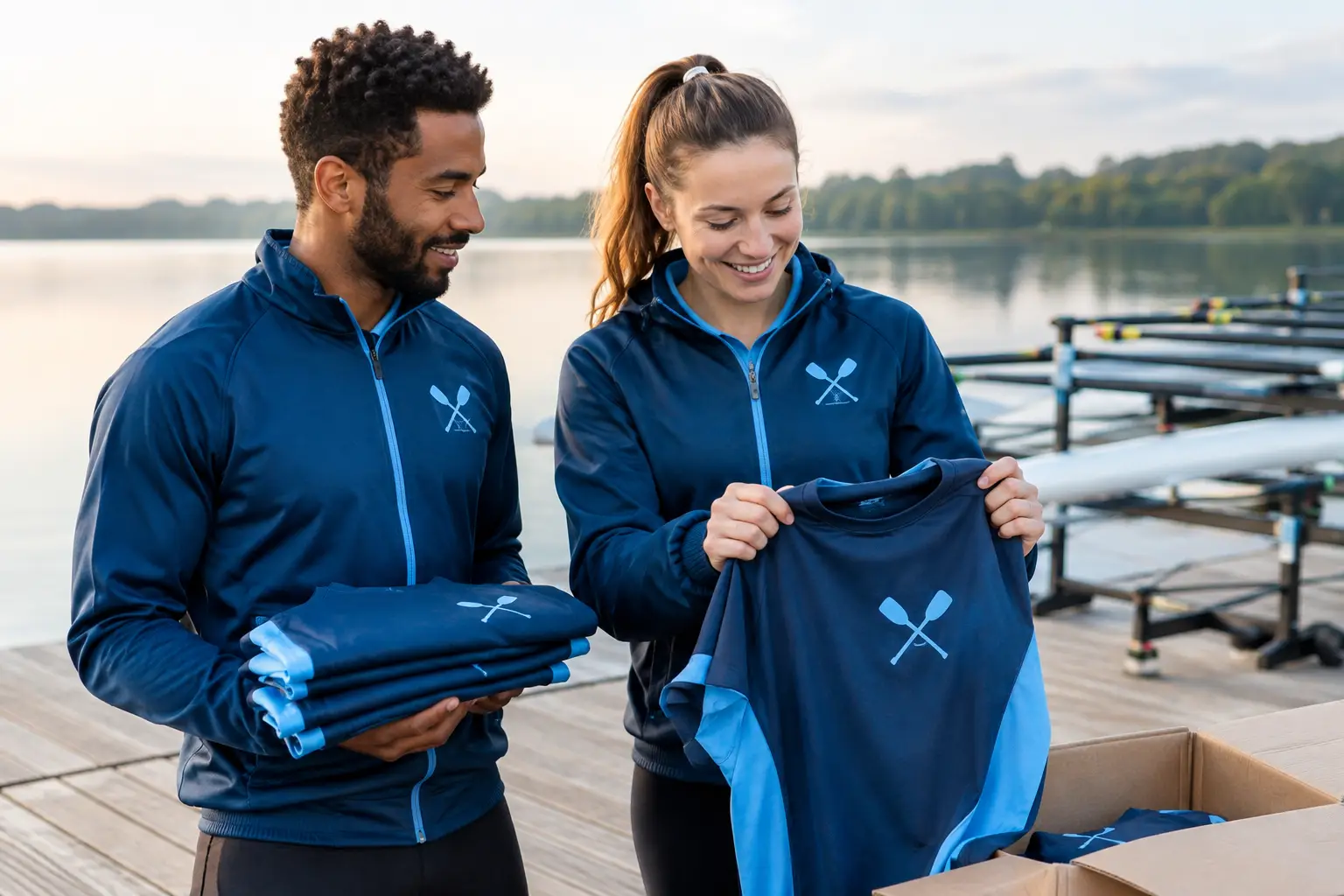
A crew can be ready for the start line and still be caught out by kit. One paddler has not submitted a size, a new sponsor logo arrives after approval, or a regatta date moves forward by two weeks. Good teamwear order management prevents these small details from becoming a last-minute problem for captains, kit officers and committee members.
For dragon boat teams and paddling clubs, an apparel order is rarely just a shirt order. It may include racerback rashies for racing, long-sleeve tops for cooler training sessions, board shorts, leggings, windbreakers, hoodies and social kit. Each garment has its own size requirements, artwork placement and purpose. The practical challenge is bringing all of that information together early enough for the finished kit to arrive when the crew needs it.
Start with the date that cannot move
The most useful date is not the day you would ideally like to place an order. It is the first race, overseas event, club tour or presentation day when the kit must be in paddlers’ hands. Work backwards from that date, allowing time for delivery, distribution within the club, production and final design approval.
For finished, approved designs, bluesupply.asia generally plans around a 30-day lead time. That gives teams a clear benchmark, but it should not be treated as the only time in the schedule. If a new design is being created, existing artwork needs adapting to a different garment, or sponsors are still being confirmed, allow additional time for design development and revisions.
This matters most before major regattas. A deadline can appear comfortably distant until a committee meeting is postponed, the treasurer needs to approve the spend, and half the squad has not checked the size chart. Building in a sensible buffer protects both the order and the people coordinating it.
Make one person accountable for teamwear order management
A club does not need a large operations team to run an orderly apparel programme, but it does need one named point of contact. That person might be the kit officer, captain, club secretary or a trusted squad representative. Their role is not to chase every paddler indefinitely. It is to set the process, communicate the deadlines and submit one clean, confirmed order.
Give that person authority to close the size window and decide what happens after it. Some clubs place a single squad order and ask late responders to wait for the next run. Others order a small number of spare tops in common sizes, particularly where new recruits are expected. Neither approach is wrong. It depends on budget, storage space and how often the club brings in new paddlers.
What causes difficulty is leaving the policy unclear. A simple message such as, “Orders close at 8 pm on Friday. Changes after approval cannot be guaranteed,” makes the process fair to the whole crew.
Use a single order sheet
One shared order sheet avoids the familiar stream of messages: “I think I am a medium,” “Can I change to long sleeve?” and “Did you get my hoodie request?” Record each paddler’s name, garment, fit or cut where relevant, size, quantity and payment status. Add a notes column only for genuine exceptions, such as a name print or a coach’s additional outerwear.
The sheet should reflect the actual garment range being ordered. A racerback rashie and a unisex hoodie are not interchangeable sizing decisions. Ask paddlers to consult the relevant size chart rather than relying on their usual high-street size or borrowing a guess from a teammate.
If possible, arrange a fitting session at training. Sample garments or a known team top can help paddlers assess their preferred fit, particularly for race kit that needs to feel comfortable through repeated paddling movement. The final choice remains with the individual, but a short fitting opportunity reduces avoidable exchanges and uncertainty.
Protect the approved design
A strong club design carries more than a logo. It makes a crew recognisable from the bank, gives new members an immediate sense of belonging and presents sponsors professionally. Once artwork has been approved for production, treat it as locked unless there is a real reason to alter it.
Late changes are costly because they affect more than one file. A revised sponsor mark may need checking for colour, placement and legibility across rashies, shorts and windbreakers. A change to the club crest can affect embroidery as well as sublimation artwork. Even a small adjustment can add design-development time and shift the production schedule.
Before approval, check the essentials carefully: club name spelling, logo version, sponsor permissions, paddler names where used, garment colours and placement. Share the proof with the right decision-makers, but avoid sending it to a large group with no final approver. Too many unofficial opinions can turn a straightforward sign-off into weeks of contradictory feedback.
A useful rule is to nominate one design approver and one operational approver. The first confirms that the kit looks right for the club. The second confirms that quantities, garments and delivery timing are right. It keeps creative decisions and order decisions moving without confusion.
Order for the way your crew actually trains and races
A race-day top is not always the right answer for every team need. Many clubs benefit from a considered range: lightweight rashies for paddling, board shorts or leggings for training, windbreakers for exposed venues, and hoodies or social shirts for travel and post-race gatherings.
The trade-off is simple. More options give members greater choice and can strengthen club identity off the water, but they also make size collection and stock management more complex. For a first order or a new squad, keep the core range focused. Establish the key race garment first, then add outerwear or social pieces when there is enough demand.
Think about event conditions too. A short-sleeve top may suit summer racing, while long-sleeve rashies can be welcome for cooler sessions, sun protection or travel events. Padded shorts are a practical choice for paddlers who spend long periods seated in the boat. The best range reflects how your team paddles, not simply what looks good in a catalogue.
Build quality checks into the order, not after it
Quality assurance begins well before a parcel leaves production. Clear artwork, confirmed garment specifications and accurate quantities give production teams the information needed to make kit consistently. Strike-off confirmation is particularly valuable for custom sublimated apparel because it gives the club confidence in the approved direction before the full run proceeds.
When reviewing a strike-off or final proof, assess it as teamwear rather than as an image on a screen. Are the colours distinct from a distance? Is the club name readable? Do logos sit clearly around seams and panels? Will the design still look balanced across different sizes? A graphic that works perfectly on a medium top can need careful consideration on smaller and larger garments.
After delivery, check the order promptly against your original sheet. Confirm the garment types, sizes and quantities before distributing them at training. If something needs attention, early checking gives the best chance of resolving it without pressure from an approaching event.
Communicate like a crew, not a call centre
The best ordering messages are brief, specific and repeated at the right moments. Tell paddlers what is available, where to find the size information, how to submit their order, how to pay and when the window closes. Then send a reminder a few days before the deadline and a final notice on closing day.
Avoid promising delivery dates to members before the design and order are confirmed. It is better to say that the club is working towards a target event than to create an expectation that depends on unapproved artwork or late size submissions. Honest updates build more trust than optimistic ones.
For larger clubs, separate messages by squad where appropriate. The senior race crew may need kit for a regatta that does not affect recreational paddlers, while a junior or social group may want a different garment mix. Clear communication keeps everyone informed without making every member sort through irrelevant detail.
Keep a record for the next order
Once the kit has been distributed, save the approved artwork, final order sheet, size data and notes on what sold well. This is valuable club knowledge. Next season, you will know whether medium long-sleeve rashies were popular, whether windbreakers needed a higher minimum interest level, and which paddlers may need replacement race tops.
You can also use the record to plan a sensible reorder rhythm. Some teams place one main order before the season, then a smaller top-up after recruitment periods. Others open orders before key international events or club anniversaries. A predictable rhythm makes it easier for paddlers to plan and reduces the pressure on volunteers.
Good kit does more than match on the pontoon. When the order is organised, artwork is approved and the delivery window is protected, your crew can spend less time chasing sizes and more time preparing to paddle together. Get your quote early, set a clear closing date and give your team kit that is ready when the next start call comes.